
November 24, 2026
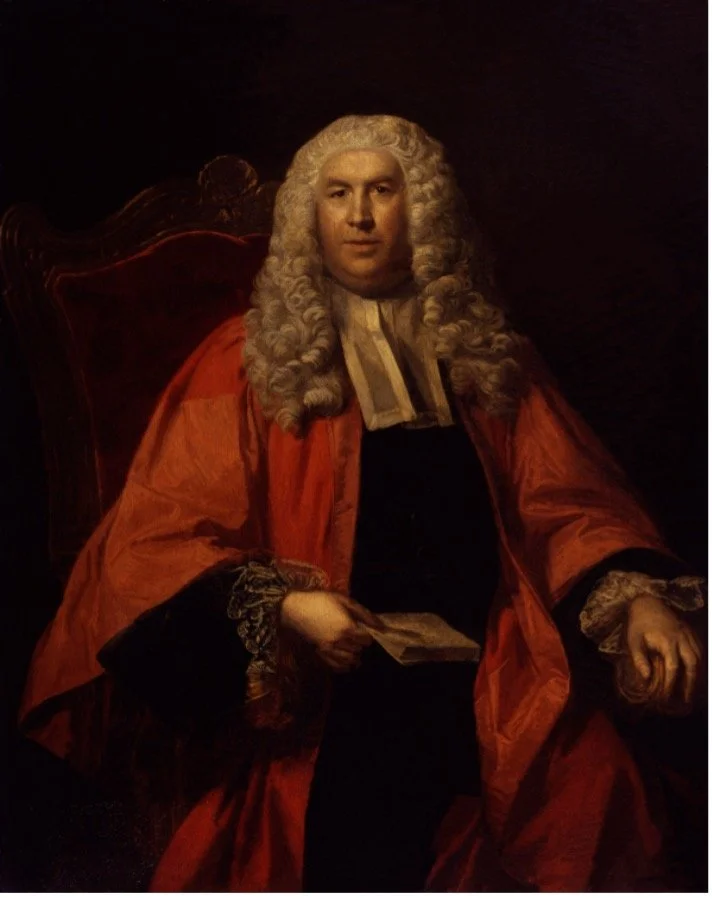
Portrait of William Blackstone in the National Portrait Gallery, London [1]
This is the second of a series of blog posts on the question, When will a court make someone disgorge his profits to you? The first post in this series is here. This post begins an explanation of the difference between law and equity.
The distinction between law and equity is an idiosyncrasy of England and countries like the United States to which England has bequeathed it. To understand it, we will go back to the source: Merry England.
I. We don’t really know much.
Practicing law for over twenty years, I’ve become so used to talking about whether a claim is legal or equitable that I now find it amazing to discover that the origin of this distinction is really not well known. As it turns out, the origin of so much of the legal framework that the United States inherited from England is not well known.
In 1765, an eminent Oxford University professor, William Blackstone, published the first volume of his Commentaries on the Laws of England, a work of enormous influence. Blackstone’s Commentaries includes an account of the origins of England’s distinction between claims at law and claims in equity, an account that was generally accepted for a long time.
As impressive as Blackstone’s readings in early modern English case law may have been, however, the view that he presented of the origin of England’s distinction between law and equity was not backed up by serious historical research. It amounted to not much more than legends and educated guesses shaped by a permeating prejudice in favor of the Anglo-Saxons over the Normans.
Even as long ago as 1835 it was noted that medieval documents were being uncovered from which a better theory of the origins of English law could be constructed. I have in mind Joseph Story, one of the most influential early justices of the United States Supreme Court, who, in 1835, published the first volume of his Commentaries on Equity Jurisprudence. In that book, Story says that it had commonly been believed “that there were no petitions of the [English court of equity], remaining in the office of record, before the 15th year of the reign of Henry VI” (that is, before the year 1436); but, he continues, the common belief had lately been debunked thanks to “many hundreds [of petitions] … lately found among the records of the Tower for nearly fifty years antecedent to the period.” And in the late nineteenth century historians in England began scouring the English countryside for whatever medieval papers they could find that reflected the workings of medieval English courts. A Cambridge professor, Frederic Maitland, was the main impetus behind these efforts, and thanks to him many of these medieval English papers were published by a group called the Selden Society that Maitland founded in 1887.
It is fascinating to read early twentieth century articles and books by members of the Selden Society in which they go back and forth trying to tease out an understanding of medieval English practice from eight-century-old papers long forgotten but preserved in archives and lately rediscovered by these trailblazer historians. You can peruse photographs of many of these original records from the Middle Ages here. And here is one of the many interesting publications of the Selden Society reproducing the text of medieval papers that had been rediscovered in the early twentieth century, accompanied by 56 pages of historical analysis and commentary. That scholarly analysis is given a thoughtful and not always supportive response in a contemporary review of the book that appears at page 330 of the journal volume hyperlinked here.
But interesting as it may be to peruse these old papers and to review the twentieth-century historians’ theories of English law’s origins, we do not need to go down that particular rabbit hole. It is enough to know what Blackstone believed, rightly or wrongly, to be the origin of English legal practices, because Blackstone’s view is the view on which law in the United States was founded. The view goes like this—
II. The court of common law was established by spinning it off from the king himself.
We will start with the common law and then turn to equity, because otherwise equity won’t make sense. As for the common law, it is best to begin with the origin of the principal court of common law.
Originally, the way that you sued someone in England is you went to the king. He would be your judge. That is how monarchies of olden times work, English or otherwise. For example, King Solomon famously acted as a judge.[2] And Livy says that in ancient Rome, before the overthrow of the monarchy and establishment of the Roman Republic, the king of Rome would act as a judge in disputes among his subjects.[3] In a standard-issue monarchy, forget about branches of government. The king is everything.
This system gets impractical when the number of people asking the king to right a wrong goes beyond the number for which the king has available time. In fact, Moses was advised that he was going to “wear away” from spending all his time judging disputes.[4] A convenient solution is for the king to point to someone standing beside him while telling the litigants that this esteemed advisor to the king will, at the king’s request, do the king’s work for him by adjudicating the dispute these litigants had brought to the king. To be sure, the king himself could always step in and take over. But the king is a busy man.
In England, certain members of the king’s court (meaning the attendants to the king) became the go-to persons for helping the king adjudicate disputes among the king’s subjects. Blackstone uses the Latin term aula regia for this group. Others call it by the Latin term curia regis.[5] This group helped with both criminal matters (where the king accuses someone of a “public” wrong) and civil matters (where one subject of the kingdom complains about another subject of the kingdom). The latter, civil matters, were referred to as “common pleas.”
This aula regia stayed by the king’s side, following the king’s movements around the country. Naturally so, because often “[t]he king used to decide causes in person in the aula regia”[6]; and even when the king did not personally handle a case, it was always possible that he might find the leisure to intervene. But in 1215, a group of English nobles were so dissatisfied with the kingdom’s affairs that they made the king, under threat of force, promise changes in his government. The promises are written in the Magna Carta.[7]
One of these changes promised by the king was that he would not appoint just anyone to act as his representative in adjudicating civil matters. Sheriffs or constables, for example, would not do. It had to be competent men called “justices.”
Clause 24 of the Magna Carta: “No sheriff, constable, coroners, or other bailiffs of ours shall hold the pleas of our crown.”
Clause 45 of the Magna Carta: “We will not make men justices, constables, sheriffs, or bailiffs, unless they are such as know the law of the realm, and are minded to observe it rightly.”
Another change that the king promised was that the justices who heard civil matters would stay put in a fixed place rather than follow the king around the countryside.
Clause 17 of the Magna Carta: “Common pleas shall not follow our court but shall be held in a certain fixed place.”
Westminster Hall was promptly chosen as the fixed place for the court of common pleas. It stayed there (or around there) until the late nineteenth century.
And that is the origin story of the court of common pleas, the English court that Blackstone, citing Edward Coke, called “the lock and key of the common law.”[8]
So much for the origin of the principal court of common law.
III. The common law was unwritten but was not viewed as “judge-made.”
What is the law that the court of common pleas administered, the law that Blackstone calls “the common law”? Nowadays, we are quick to refer to the common law as “judge-made law.” It seems obvious to us that necessarily the common law is judge-made because it was never enacted by the legislature (that would be a statute), so who else could be making it other than the judges themselves?
Obvious as that may be, Blackstone did not agree with that. Blackstone describes the common law as “general customs” and “immemorial usage.”[9] Elsewhere he says that the common law is “nothing else but custom, arising from the universal agreement of the whole community.”[10] In another place he says that the common law is “[t]hat ancient collection of unwritten maxims and customs.”[11]
We generally associate the common law system with a respect for judicial precedents. And Blackstone agrees with that. You might think this implies that judges make the common law. But even the common law’s respect for precedents is not enough to force Blackstone to admit that there is anything judge-made about the common law. Blackstone gives two reasons for respecting precedents. The first is that precedents are “the principle and most authoritative evidence, that can be given, of the existence of such a custom as shall form a part of the common law.” The second is that a respect for precedents “keep[s] the scale of justice even and steady, and not liable to waver with every new judge’s opinion.” He adds, however, that a precedent can be abandoned if it is “most evidently contrary to reason.” And if a precedent is abandoned, then, according to Blackstone,
the subsequent judges do not pretend to make a new law; but to vindicate the old one from misrepresentation. … [I]t is declared, not that such a sentence was bad law; but that it was not law; that is, that it is not the established custom of the realm, as has been erroneously determined.[12]
Upshot: From the requirement that judicial precedents be respected, it does not follow (in Blackstone’s view) that judges make law.
This view of the common law is not just academic. It is important when we come to distinguishing equity from the common law. But before we get to that, let me digress for a moment to tell you how this view of the common law had important practical consequences in the United States.
Here we have the courts of lots of different states and also the courts of the federal government all separately administering “the common law.” So, consider a case that is in a state court, say, in New York. It can happen that this case is handed off by the New York court to a federal court just because one of the parties is not a New Yorker, on the theory that no one should have to wonder, when it is all over and done, whether the New York court slyly found ways to favor its own.
After the case is handed off by the New York court to the federal court, the parties will start arguing over whether the common law requires this or whether it requires that. Then you have to ask, is the federal court obliged to respect New York’s precedents on whether the common law requires this or requires that? Everyone may agree that if the case had stayed in a New York court, then a certain New York precedent would definitively resolve the dispute over what the common law requires. If the common law is judge-made, then that is the law of New York: It is whatever the New York precedent established. But a famous United States Supreme Court case, in an opinion written by Joseph Story, declared that the federal court can reject the New York precedent.[13] According to this 1842 Supreme Court case, the federal court can decide that the New York courts got the common law wrong.
You might object that this makes no sense because now New York cases will get decided by a different “common” law for no reason other than that there happened to be a non-New Yorker in the case, and where is the fairness in that? But it makes sense if we accept Blackstone’s view that the common law is not judge-made. As Joseph Story expressed the view when explaining the decision that the federal court can reject New York precedent:
[I]t will hardly be contended that the decisions of Courts constitute laws. They are, at most, only evidence of what the laws are; and are not of themselves laws.[14]
That is precisely Blackstone’s view. Much later, a critic of Story’s and Blackstone’s idea of the common law, Oliver Wendell Holmes, described the idea as that of “an august corpus” that some judges perceive better than others, “a transcendental body of law outside of any particular State but obligatory within it.”[15]
It was not until 1938 that the United States Supreme Court renounced this idea of the common law.[16] Our modern view is that the law is just whatever the state says the law is, and sometimes “the voice adopted by the [s]tate” is the state legislature’s voice, but other times it is the state judges’ voice.[17] So, today we see the common law as just whatever the courts say it is; we see it as judge-made law. Today, therefore, if a federal case is understood to be governed by New York law, then the federal court must follow the New York courts’ determination of the common law — or, as we now say, their determination of “New York common law.”
The important point to keep in mind when we come to equity is that the common law really was conceived by Blackstone (and Story) as a set of general rules that are not to be tinkered with. Judges may apprehend the common law well or apprehend it less well, but they are powerless to alter it.
So much for the common law. Our next installment in this series will distinguish equity from the common law.
[1] This image is taken from Wikimedia Commons. In the United States, the image is within the public domain.
[2] 1 Kings 3:9-28.
[3] See, e.g., Livy 1.41.5-6.
[4] Exodus 18:18.
[5] Arthur William Holland, “Curia Regis,” in the eleventh edition of the Encyclopaedia Britannica (1911).
[6] The pagination of the first edition of Blackstone’s Commentaries is conveniently noted in the margins of a 2016 republication by Oxford University Press. All my citations to the Commentaries will be to the pages of the first edition. The quotation here is from Book III, page 41, note p.
[7] Blackstone says, at Commentaries Book I, page 123, that the Magna Carta was “obtained, sword in hand, from King John.” The Magna Carta was written in Latin. The English translation that I quote from is by Ernest Flagg Henderson, available here. It is a translation of the original 1215 version of the Magna Carta. There are some changes in a 1225 “re-issue” of the Magna Carta by King Henry II, but the 1225 version is hard to find online. This website says that the 1225 version is the real, legally effective document.
[8] Book III, page 40. There is another origin story for the common law court that handled criminal cases (the king’s bench) and for the common law court that handled debts owed to the king (the court of exchequer). But we want to know when a court will make someone disgorge his profits to you, and I have digressed enough already.
[9] Book I, page 68.
[10] Book I, page 460.
[11] Book I, page 17.
[12] Book I, pages 69-70 (emphasis original).
[13] Swift v. Tyson, 41 U.S. 1 (1842).
[14] Id. at 18.
[15] Black & White Taxicab & Transfer Co. v. Brown & Yellow Taxicab & Transfer Co., 276 U.S. 518, 533 (1928) (Holmes, dissenting).
[16] Erie R.R. Co. v. Tompkins, 304 U.S. 64 (1938).
[17] Id. at 79 (quoting the dissent by Holmes in Black & White Taxicab).